

by
Izang Alexander Haruna
Reading Bewitchment in Nasiba Babale’s Pickled Moments
“I am black,
I am light,
I am the radiance of poetry,
And I am the poet of light.”

Nasiba Babale.
What we have above from Nasiba Babale’s Poet of Light belongs to the latter category of pieces that do not argue; they simply affirm. It is not the one to knock; it just enters. And in that assertion, something happens. The reader is not persuaded so much as touched, almost altered. This is the quiet work of bewitchment. Pickled Moments is an exercise in witchcraft—not witchcraft as superstition, evil, or moral panic, but witchcraft as uncommon genius, as extraordinary agency, as the capacity to wield immaterial forces—language, memory, voice, light—and make them bear upon human and material reality. Poetry, after all, has always trafficked in the unseen. Before us is a collection that enchants attention, illuminates the ordinary, and stages subtle transformations around love, identity, loss, homeland, and selfhood. Babale does not merely describe experience; she conjures it. Her poems perform acts of social and emotional magic—binding wounds, reclaiming names, and turning what has been marked as lack or shame into radiance.
For starters, it’s only fitting to rescue witchcraft from its conventional meaning, which has made a mockery of that ingenious term. For the intellectuals, witchcraft has long been understood not as irrational fantasy but as a system of meaning, a language for explaining power, misfortune, and agency where formal institutions fail. E. E. Evans-Pritchard’s classic Witchcraft, Oracles and Magic among the Azande demonstrates that witchcraft functions as a coherent social logic, an explanatory framework through which communities understand causality and responsibility. Witchcraft, in this sense, does not deny reason; it reorders it. It gives name to unseen forces at play behind events seen and felt.
Silvia Federici, in Caliban and the Witch, goes further to historicise witchcraft as a gendered political category. The witch, she argues, became a target not because she was evil, but because she embodied alternative forms of knowledge—healing, communal memory, reproductive autonomy—that threatened emerging structures of capitalist and patriarchal power. The witch is thus not merely a figure of fear but a repository of suppressed genius, especially female genius.
When extended metaphorically to poetry, witchcraft becomes a way of naming artistic acts that alter perception, unsettle dominant narratives, and wield invisible power. Poetic witchcraft names the incantatory force of repetition, the spellwork of imagery, the ritual of voice. It is language doing more than representing; it is language acting. Babale herself invites this reading when she names herself “Poet of Light.” Historically, illumination and occult knowledge have often overlapped. To illuminate is to bring light to what is hidden; the occult, from occultus, concerns what is concealed. Witchcraft and illumination meet where hidden knowledge becomes visible power. Babale stands precisely at that junction.
In Babale’s hands, wordcraft becomes witchcraft—not in the sense of superstition, but as an elevated practice of human agency—where language, that most fragile and abstract of tools, is wielded with such precision that it bends perception and calls realities into being. One is compelled to pause and wonder: what is it, after all, that allows a scatter of marks we call alphabets to be arranged, pronounced, and agreed upon as meaning? And what greater mystery lies in the further act of arranging these meanings together so that they generate still deeper meanings—emotions, memories, recognitions—within the minds of others?
The poet stands at the apex of this strange economy. It is here that Babale’s art reveals its bewitching quality: she employs language so deftly that what she names begins to live, to glow, to trouble and to heal. In this regard, Babale fits seamlessly into what John Paul II so craftily articulated in his 1994 Letter to Artists: “None can sense more deeply than you artists, ingenious creators of beauty that you are, something of the pathos with which God at the dawn of creation looked upon the work of his hands. A glimmer of that feeling has shone so often in your eyes when—like the artists of every age—captivated by the hidden power of sounds and words, colours and shapes, you have admired the work of your inspiration, sensing in it some echo of the mystery of creation with which God, the sole creator of all things, has wished in some way to associate you”
What is especially useful for this reading, however, is John Paul II’s careful differentiation between creator and craftsman—a distinction that illuminates the precise nature of poetic witchcraft:
“What is the difference between “creator” and “craftsman”? The one who creates bestows being itself, he brings something out of nothing—ex nihilo sui et subiecti, as the Latin puts it—and this, in the strict sense, is a mode of operation which belongs to the Almighty alone. The craftsman, by contrast, uses something that already exists, to which he gives form and meaning. This is the mode of operation peculiar to man as made in the image of God… God therefore called man into existence, committing to him the craftsman’s task. Through his “artistic creativity” man appears more than ever “in the image of God”, and he accomplishes this task above all in shaping the wondrous “material” of his own humanity and then exercising creative dominion over the universe which surrounds him. With loving regard, the divine Artist passes on to the human artist a spark of his own surpassing wisdom, calling him to share in his creative power. Obviously, this is a sharing which leaves intact the infinite distance between the Creator and the creature, as Cardinal Nicholas of Cusa made clear: “Creative art, which it is the soul’s good fortune to entertain, is not to be identified with that essential art which is God himself, but is only a communication of it and a share in it”.
From this vantage point, Babale’s poetic witchcraft does not claim divine creation but participates in this sacred craft: taking what already exists—language, memory, pain, love, history—and reshaping it so that it means otherwise. Her poems do not create ex nihilo, but they do something just as potent: they reorder the given world until it reveals hidden light. This is the quiet miracle of her art, and the source of its extraordinary agency. Every single poem in the collection is a testimony to this very point.
The opening poem, “Deserted,” demonstrates enchantment at its most intimate. The speaker confesses: “He says that I am a poet/ So I will always have words/ But there are no words in me/ I struggle to say them beneath/ The weight of his gaze.” Here, love does not inspire speech; it suspends it. The gaze of the beloved becomes a spell under which language bows. The poet, ordinarily one who has much words on the lips, is rendered mute. This is not mere description; it is enactment. The lines themselves hesitate, they stagger, as though bearing something heavy.
The poem’s concluding rhetorical questions: “What power do words have / Where love rules?” do not seek answers. They circle, loop, returning the reader to the same uncertainty. This movement in circle is a form of incantation. The reader is drawn into the same liminal space as the speaker, caught between speech and silence. Read through the witchcraft frame, “Deserted” becomes a casestudy in enchanted power relations. Who wields power here? The lover? Love itself? Or the poet, who transforms this paralysis into art? The poem implies then that even enchantment can be reclaimed. By giving name to the spell, the poet begins the loosening of it.
In “How I Wear My Accent,” Babale turns language itself into ritual. The poem’s phonetic spellings—“Wraffed in all za shades op my accent”—do more than represent speech; they perform it. On the page, accent becomes embodied. At this point, magic is for protection. In a world where accent is used to measure intelligence and belonging, the poet refuses correction. She insists on sounding like herself. The poem becomes a ward against erasure, a ritual affirmation of origin. The witchcraft here consists in reclamation of identity which naturally implies agency and dignity. What has been mocked becomes sacred. What has been stigmatized becomes a source of power. Nasiba’s dramatisation of the hausa accent rather than smoothing it out casts a spell of self-possession. Bizuum Yadok captures the heart of the poem with his deft critique: “The poem evokes Hafsat Abdullahi’s poem, ‘To the Girl in English Class’ and it speaks about resistance to an imposed identity, a postcolonial phenomenon. The poet makes it clear that having one’s mother tongue superimposed on her second language, in this case English, is nothing to apologize for and it does not, using any conceivable yardstick, measure intellect.”
Illumination and alchemy are easily the point of enchantment that resulted in interpreting this collection this way. The poem “Poet of Light” (which is also the monicker of the poet under review) is the collection’s most manifest act of self-naming. The poem’s central alchemy lies in its inversion: blackness becomes light. Melanin radiates. She shouts: “I am black,/ I am light…” This is metaphysical sleight of hand. A trait historically coded as lack is transformed into abundance. The poem does not argue against colorism; it dissolves its logic altogether. Babale is not alone in this identification and confession. The retired poet now painter Supreme Gilbert enacted this very phraseology “we are black/ and we are light” in the feature track Wild Heart by Gideon King. The difference is that while Supreme went Ujamaa, Babale personalised it and ensured in radiates in her body of work.
Seen through the symbolic lens of alchemy, Babale’s self-fashioning as “Poet of Light” works out a transmutation of value: what history has rendered base or obscured—blackness, the self denied—is worked upon until it gleams with renewed worth. Like the alchemist who turns lead into gold, she converts silence into speech and stigma into power, not through softness but through a revelatory force that disturbs settled orders. Her illumination is thus a form of spiritual alchemy—witchcraft as transformation—where revelation does not merely disclose truth but remakes the terms by which beauty and being are known.
Babale’s poetic witchcraft is deeply feminist, not the razzmatazz identified with bitterness of gender war but with the confrontation of hierarchies that subdue the human, systems the suffocate a healthy environment, a feminism that calls for wholesomeness, be and let be. Like Federici’s witch, her speakers carry embodied knowledge—of skin, accent, love, grief, home, value of life. The poems reclaim women’s experiences as point of wisdom not just weakness. Within the collection one can discern some protest poetics or poetics of rage as E. E. Sule will call it.
Because they serve as conscience of society, the poems do perform social repair. Poems about homeland and war do not merely lament; they remember communally. The sections ‘The Price of Homeland’ and ‘This is Not a Home, This is Not a Country’ furnish us with multiple pieces that send home the point. In the former, the poem of the very similar title as the section tells us what is lost in war, it reminisces Clark’s The Casualties; it tells us the price sums up to “people who do not recall what happiness feels like,/ in death, in war, in grief, in mourning,/ in bombs, in bullets, in fire, in smoke.” It is not surprising then that when the persona, in another similar piece, was asked to spell PEACE found it impossible on the premise that she can’t spell what she doesn’t know. Peace she may not know but she does know the price of homeland lost, like Darwish, she doesn’t know who sold the land but she knows who paid the price.
If in the said section she spotlighted global issues, she turns to the local in the next. No grief is worse than the one which has home as the object. The gloom and doom seem palpable; the country is hardly a home, and to paraphrase Achebe it could read ‘there was a home.’ The tragedy of our nation is rendered in four lines: “We are one nation/ When united in victory./ We are two regions/ When visited by calamity.” Why won’t it be so when stereotypes seem the national anthem? Worse still that home is “a cemetery for dreams and abandoned hopes…a store laden with grief…the resting place of doom.” These pieces made Ahmad Mubarak liken Nasiba’s nationalism to Dike Chukwumerije’s. It is the gloom that characterise the two sections above mentioned – then add the personal grief in A Buffet of Loss – that makes us appreciate all the more the light that Nasiba brings to the table of conversation.
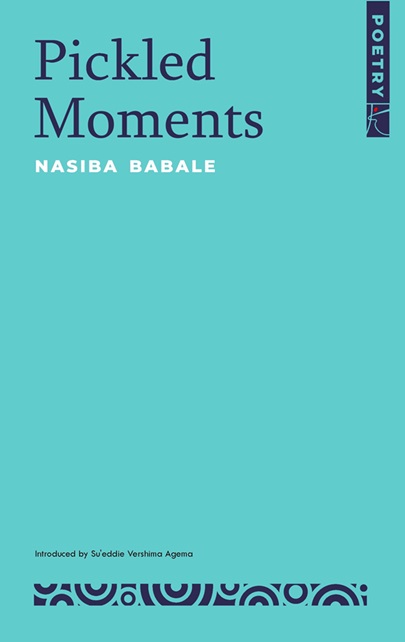
Read as witchcraft, Pickled Moments reveals itself as a book of social magic. It is fitting to end this reflection with the section from whence the collection takes its title. Su’eddie Agema aptly defined Pickled Moments as ‘collection of seasons’ captured, moments arrested by the camera of poetry, preserving them for the eternal memory. If Thomas Moore is deemed a man for all seasons then Nasiba Babale comes close to being a poet for all seasons. She’s the artist of the mudane, the poet of perfect pieces, the poet whose poem is not a poem, a poet found somewhere on the street of Kano eavesdropping with the future as it sits next to the past learning the art of dropping accusations. After the grief and losses, the collection is something of healing with olive.
Decipher Moore has always projected poetry as magic, spell enchanting. Through incantation and illumination, Nasiba Babale takes up the very spirit of the craft to transform shame into radiance, marginality into power, and memory into ritual. Her poetry does not merely reflect the world; it acts upon it. Is it surprising then that Ahmad Mubarak confesses: “I haven’t read enough of Nigerian poetry collections to have the wherewithal for audacious assertions about this poet, but I’m pleased with her art which makes poetry to be intractably easy without compromising its prestigious elegance and the uniform identity that her poems wear.” There goes the result of an enchantment.
Babale’s intertextual gestures, drawing from Gibran, Darwish, Abu Toga, Sidi, Qabbani, Bukowski, Sabouke, Mary Oliver, and Rasaq Malik Gbolahan amongst others, function like an ancestral grimoire. Each epigraph is a summoning. Each homage situates her within a transnational coven of spellbinders. It says she comes from a line of poets, scratch that – witches and wizards. If this lineage says anything then it is that poetic power is shared, inherited, communal. Babale’s magic is not solitary; it is learned, adapted, passed on.
If anyone sees through Babale then it is none other – paradoxically – than the one whose monicker is like an antithesis to hers, the enigmatic poet of dust Umar Abubakar Sidi; he saw her through and through in saying: “this poet has mastered the art of lightness. This poet has taken weight off the language of loss. These poems shine. These poems illuminate. Nasiba is truly the poet of light.” Babale earns her title. She is a poet of light—not because she denies darkness, but because she knows how to work within it, and still make something glow. She joins the elite cultists like Salman Rushdie to “name the unnameable, point at frauds, take sides, start arguments, shape the world, and stop it from going to sleep?”
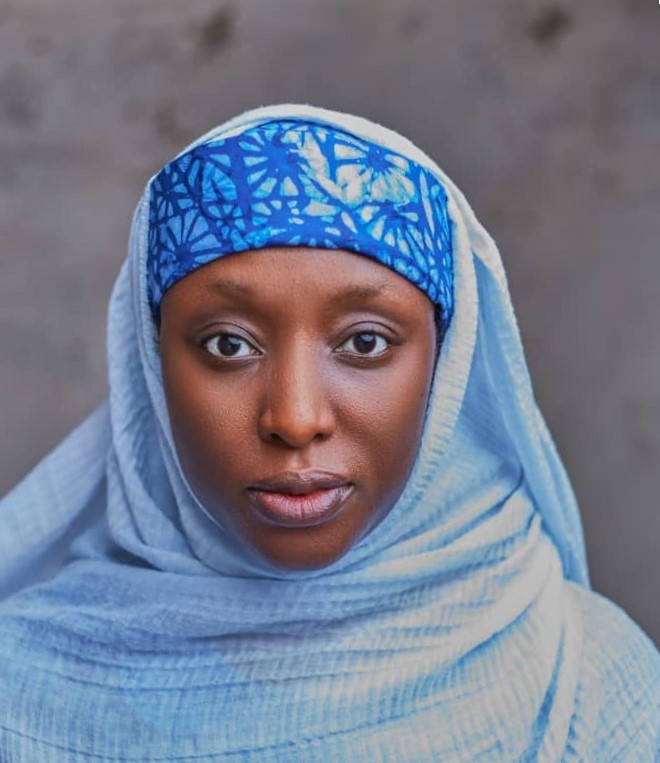
Izang Alexander Haruna is a poet and critic, with interest in African philosophy, culture and religion. He was shortlisted for E.E. Sule/Sevhage Prize for African Literary Criticism. His debut publication is a critical work Letters to 42 Writers (2024) and the Chapbook In a Man’s Body (2025). His reviews and essays have appeared in The Nigeria Review, ANA Review, Nestle in the Rock Anthology (ANA Plateau), Guardian Newspaper, Business Sunday News, Con-Scio Magazine, amongst others. He has appeared as panelist at Benue Book and Arts Festival, Plateau Literary Festival, Jos Bookfair, AfrikaWrites Series.
