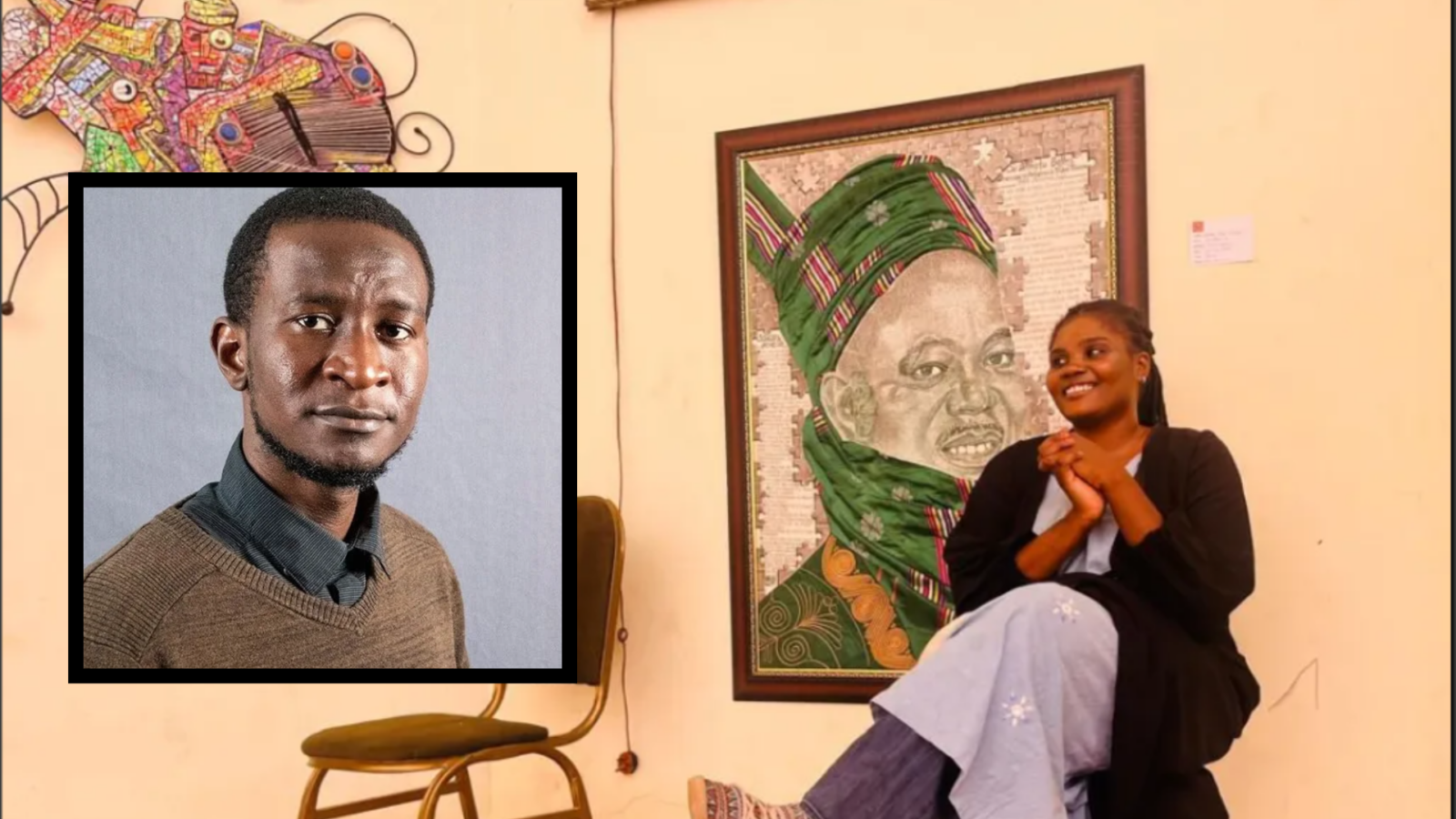

Complex Metaphors and Naming features poet and Mississippi State University professor Saddiq Dzukogi in conversation with poet and fabric designer Star Zahra, whose sophomore collection, Girls and the Silhouette of Form, won the 2025 Association of Nigerian Authors/KMVL Prize for Poetry. Dzukogi was also a finalist for the ANA Prize for Poetry in 2012, 2014, and 2016. The interview was recorded in March 2025.
Saddiq Dzukogi is a Nigerian-born poet based in the US where he is an assistant professor of English at Mississippi State University. He is the author of Your Crib, My Qibla (Nebraska, 2021), winner of the Derek Walcott Prize for Poetry and the Julie Suk Award and finalist for the Nigeria Prize for Literature.
Star Zahra is a Nigerian poet, essayist and textile designer. She is the author of Girls and the Silhouette of Form, winner of the 2025 ANA/KMVL Prize for Poetry. Her work has appeared in Isele Magazine, Brittle Paper, The Lagos Review, Konya Shamsrumi, Journal of African Youth Literature Olongo Africa, and other publications. She was poetry editor for Guesthouse Magazine Iowa and currently submissions editor for Orison Books, a US-based literary press.
Saddiq Dzukogi: First, congratulations on the publication of your book—I’ve been thoroughly enjoying the poems. And congratulations on the wonderful attention it’s receiving. With so much poetry emerging from Nigeria, it’s thrilling to see how you’re advancing that conversation.
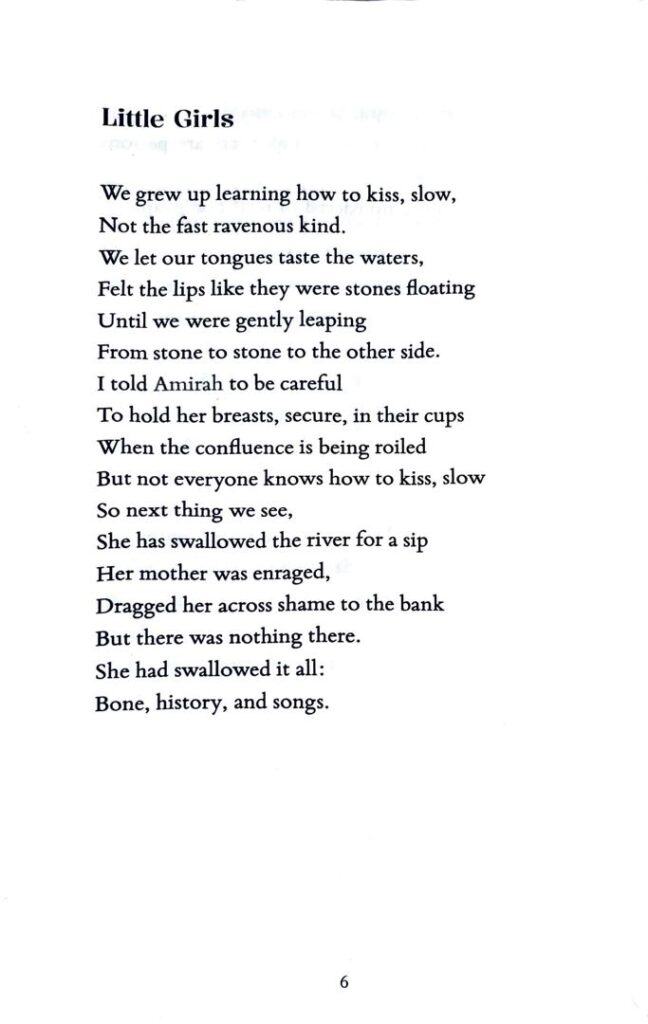
In your poem, ‘Little Girls,’ the river functions as a potent image, with Amirah’s act of swallowing it whole leading to her internalising ‘bone, history, and songs.’ Could you elaborate on how these elements—bone, history, and songs—symbolise the complexities of cultural or personal identity?
Star Zahra: Thank you so much for your very kind words, Saddiq. You’re right that so much poetry is emerging from Nigeria, with so many amazing writers, and I’m just as thrilled to be part of the ongoing conversations revolutionising not just the landscape of what African poetry has been before now but also our own culture and the ways that we interpret it.
In Little Girls, I use bone, history and songs as personal metaphors to describe tradition, culture and morality. Bone is one of the most intimate things that define us. When you talk about cremation, for example, and the process of that, it shares the nature of tradition, which is the backbone of our identity and beliefs as people. In songs, we have always passed our folklore and parables centred on ideas of morals, virtues and legends. These act as beacons to communities and are trusted to help guide young people.
History is culture that has happened and culture is history happening. They are inseparable. Amirah swallowing these elements first implies a disregard for communal admonitions and norms that are central to members of this shared identity. The consequences are ultimately feelings of isolation or guilt which can be very hard for a young woman and explains why the mother dragged her back, hoping to find something salvageable.
Saddiq Dzukogi: Also, could you speak on how the tension between ‘slow’ versus ‘ravenous’ experiences reflect societal expectations placed on young women as they navigate growth and autonomy?”
Star Zahra: A lot of expectations are placed on young women growing up. There are so many definitions of what is ideal and what is not, in terms of sexuality especially. I find it exhausting that we do not see the error of such policing. We must decide on what is most beneficial – fear that inspires secrets or confidence that allows guidance. In African societies where things like premarital sex, lesbianism and, in some cases, simply a sense of exposure are frowned upon with such hostility, these women have to perform their expected roles. The women who do not are labelled and condemned, fueling feelings of abandonment and shame. This does more harm than good.
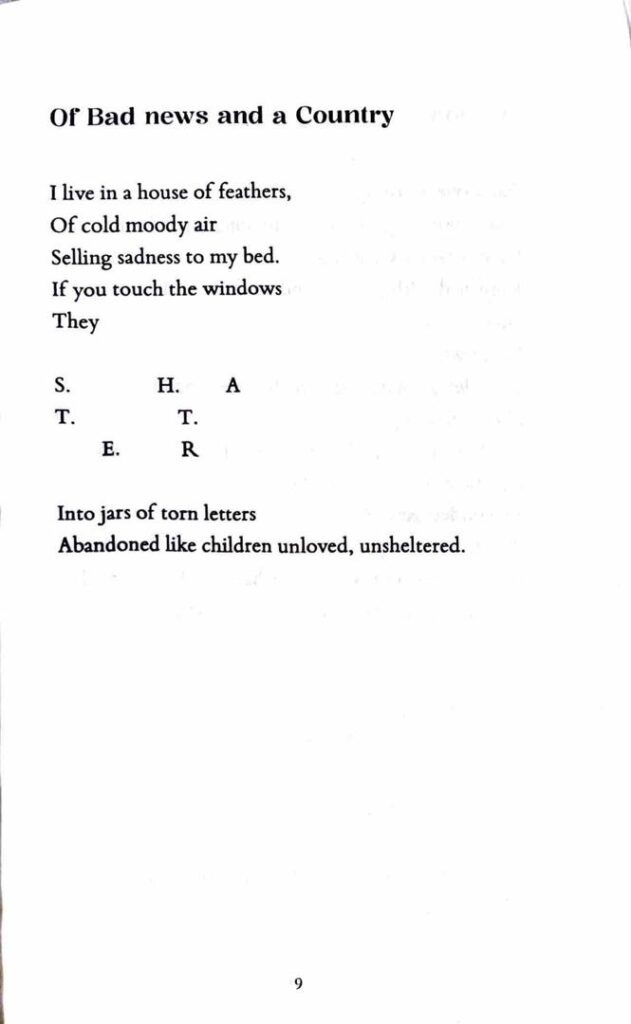
Saddiq Dzukogi: Your poem, “Of Bad News and a Country” effectively conveys a sense of fragility and isolation. I’m particularly struck by the metaphor of living in a “house of feathers” and the distinctive typographical choice in “S. H. A. T. T. E. R.” Could you share what inspired this specific fragmentation of the word, and how it relates to the theme of broken communication suggested by the “torn letters” in the final lines?
Star Zahra: As a poet and an artist, I wanted to bring into this collection a sort of artistic touch. That’s where foregrounding comes in through graphological deviation. The significance of this choice is to visually represent the meaning of the word in a way that equally highlights the chaotic state of life here as a Nigerian. In the reality of a democracy that is non-existent, citizens do not feel like they are heard, seen or even considered thoughtfully at all. Writing about Nigeria feels quite hard, there’s an abundance of words trying to align. It is hard to write about it because it is hard to accept the truth.
Saddiq Dzukogi: In “To Call the Sun the Sun” the transformation in this poem from woman to friend to poet to child creates an enthralling journey of self-definition, particularly how it culminates in “Learning to call the sun the sun.” I’m intrigued by how you contrast what you are against and what you are not, especially in the lines about Kano and the buried lovers’ story. Could you tell me more about how this specific place and narrative shaped your exploration of identity in the poem? The way you move from complex metaphors to that deceptively simple final line about naming things directly seems to suggest a kind of unlearning or stripping away.
Star Zahra: I think it’s really not particular to Kano as it is to just about any northern state in the country. I’m from the Idoma ethnicity of Benue State but I was born and raised in Warri, Delta State, where my dad served as a firefighter with the Nigeria Ports Authority. We left Warri for Abuja when I was 12, and the culture shock was massive and piercing. The weather, the harmattan, was absolutely strange, and the way that people dressed and talked. I think that was a defining moment, to be able to see these two places distinctively and to experience them and perhaps the wonder of being a stranger to one’s home.
That feeling—of belonging and estrangement—has followed me ever since. It has shaped my work and deepened my engagement with Northern culture and art. This poem is about that journey, about moving through labels and identities until arriving at something simple and undeniable.
Saddiq Dzukogi: What did writing this book teach you, first as a person in the world and as a poet paying attention to that world?
Star Zahra: It definitely taught me a lot, but not things I didn’t know, just things I didn’t see in a certain way – things about resilience and those that are constantly evolving, of which I am one. There was a lot of self-reflection in writing this book and I can see it in the reading of the book as well. It explores experiences that connect us as people fundamentally, whether these are good or bad and it talks about them with an acceptance that encourages us to remember our state of being human. It is something that we often forget or try to ignore because we have ideas of super-heroism that can make being human feel flawed.
Saddiq Dzukogi: A lot is happening in the world; for you, what do you think is the responsibility of the poet, if any?
Star Zahra: The poet has a responsibility to himself – to do something with this one wild and precious life, to not go gently and to not linger at crossroads. Poems are emotional, cultural, linguistic and political photographs that annotate the intangible elements of human existence. They are the most sophisticated archives of everyday life being documented and that is no easy job.
Saddiq Dzukogi: What advice do you have for poets writing today?
Star Zahra: I’d say write it! – because no one else will write it like you would. We are standing on the poems of many people before us. We’ll need to pay it forward.


