

Crossing the Rubicon by Sulaiman Zailani
Foreword, by Ismail Bala.
At its core, poetry often involves crossing: crisscrossing and intersecting lines, word patterns, arrangements, and metaphorical movements; words traverse, images zigzag, and ideas cross over from one poem to another. It moves from silence to speech, from inner turmoil to expression, and from the visible world to hidden truths. In Crossing the Rubicon, Suleiman Zailani takes readers on a lyrical journey of love, memory, grief, faith, longing, and spiritual awakening. The collection serves as both a personal account and a thoughtful offering. It comes from a voice deeply engaged with poetry, not just as a passion, or a one-off thing, a fad or a decoration, but as a witness, a release, a commitment, and a reflection on morality.
Through these pages, the poet shifts easily and effortlessly between intimate confession and public reflection. Romantic tenderness coexists with metaphysical longing; elegies interact with invocations; poems of domestic love and companionship expand into thoughts on mortality, transcendence, and the challenges of human striving. This results in a collection filled with emotional honesty and spiritual depth, continually seeking meaning amid the changing states of human life.
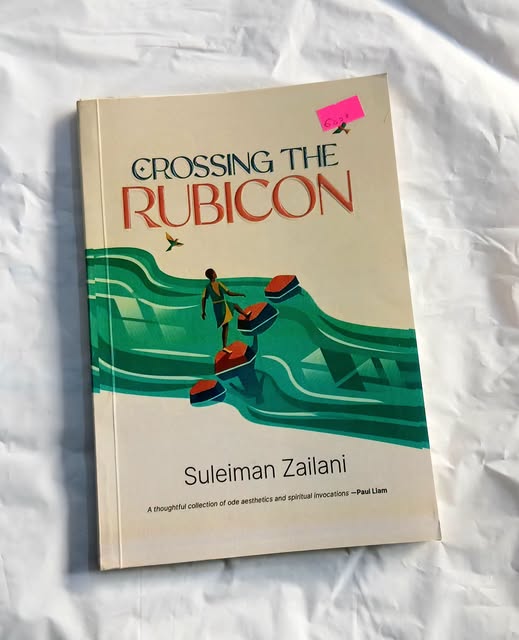
At the centre of this second collection by the poet (after the success of his debut, Eruptions from Within) lies a restless quest for understanding. Whether reflecting on the sacred duties of love, the fragility of memory, the practice of worship, or the role of the poet, the Sufi poet, Zailani writes with a voice rich in invocation and desire. His poems often follow the rhythms of prayer and address, reaching out toward loved ones, mentors, friends, society, and ultimately toward the Divine. In this way, Crossing the Rubicon joins a long tradition of spiritually influenced poetry where language serves as a way to seek clarity, comfort, and transcendence (in this way, Zailani shares a lot in common with other Sufi-influenced poets in Nigeria: Umar Sidi and Ba Sabouke).
The impact of Islamic spirituality and Sufi awareness runs deeply through the collection, especially in poems that reflect on repentance, divine mercy, service, and the soul’s desire for peace. Yet, these poems stay rooted in real-life experiences. The spiritual is never separate from the ordinary human world; it emerges through love, friendship, loss, longing, struggle, and memory. The poet’s thoughts on devotion are thus interwoven with his observations on humanity itself.
Equally impressive is the collection’s focus on emotional openness. These poems do not shy away from tenderness. They view love as a refuge, poetry as comfort, and memory as a living force that sustains the self during tough times. The poems dedicated to family, friends, mentors, and literary colleagues reveal a deeply relational mindset: one that sees human connection as both emotional sanctuary and spiritual duty.
Spanning broad themes, Crossing the Rubicon explores various areas: the joys and worries of romantic love, the weight of public conscience, the certainty of mortality, the quiet contemplation of worship, and the enduring mystery of artistic creation. A consistent belief in the power of language runs through these themes. For Zailani, poetry becomes a way to preserve memory, face despair, affirm faith, and strive for moral and spiritual renewal.
Throughout the collection, there is a clear tension between human fragility and hopeful transcendence. The poems acknowledge our limitations: failures, fears, temptations, and sorrows, while also asserting the possibility of grace, redemption, and inner light. This balance between vulnerability and ambition gives the collection much of its emotional impact.
Ultimately, Crossing the Rubicon is a book marked by desire: a desire for truth, for closeness to the divine, for emotional satisfaction, for beauty, for meaning, and for the peace that exists beyond the chaos of worldly life. Its poems aim not just to describe experiences but to change them into moments of reflection and spiritual connection.
In a time increasingly defined by distraction and fragmentation, Suleiman Zailani’s poetry reminds us of the lasting power of thoughtful language—the ability of verse to comfort, to remember, to question, to celebrate, and to shed light on the hidden aspects of the human soul.
Ismail Bala is a Nigerian poet, translator, and critic whose work bridges classical poetics and modern sensibility.
