
These three poems by Tanure Ojaide were especially chosen for The Bala Selection.
The Bala Selection is a bi-weekly poetry feature curated by Ismail Bala for Konya Shamsrumi, showcasing distinctive new voices and resonant works from across Africa and beyond. Through his discerning eye, each selection highlights the craft, music, and emotional clarity that define contemporary poetry in its most luminous form.
Ismail Bala is a poet, translator, and critic whose work bridges classical poetics and modern sensibility, and whose mentorship has shaped a generation of emerging African poets.
Mummy & Her Daughter
(for Anne & Eloho)

“Mummy!” erupts from silence.
“Yes!” always follows it
with a leap, as if over an abyss
separating daughter and mother.
“I’m coming” is met with a turn from the child,
and within a minute the mother is at her side.
It takes a trembling heart to hear that cry.
A taut connection ensures the lightning response.
That is how disability pains are reduced drastically
by the love of one whose presence is a magic spell.
Mummy never ignores her call for relief.

Later relieved, her laughter reinforces hers,
and laughter fills the home with cheers.
Can the house of the sick light up with cheers?
Of course, it does, and it is wholeheartedly so
when it opens to the call that rises high
and across space with effluence.
The sick might not move with legs,
but her spritely cursor mind runs round.
I witness both the caller and the summoned
sit beside each other at the dining table
absorbing themselves in love vapors.

So, every task, however ponderous, is carried out
with prayers for a future return to normal life.
Mummy cleans and bathes her without a wince.
Beauty of the clean body evinces joy,
and Mummy regales her cleansing of the body
that enriches the soul that shines without limit.
“My child is a beauty,” she sings to herself,
her day filled with cool breeze of their glow.
They have their breakfast close to noon,
and as I take siesta, they have a light lunch.
Their dinner comes an hour after my own.

Who will not sing at a mother’s passing?
What good child will not remember or praise
the mother’s sacrifice to raise him or her up?
“Sweet Mother, I will never forget you” echoes.
Mother is gold. There is no one like Mummy.
Clasp your mother and you are safe in her arms.
Enter your mother’s home and you find a refuge
to eat, play, laugh, and live a happy life.
Give her who gives what she has to you!
She is your mother whose nine-month carriage
provides her with an abundance of joy and your life.

Mother of a disabled one lauds the translucence
that brings calm to her being a woman and a great one.
She lives in an enchanted world of contentment
and attachment to her seed turned into a lady.
She prepares welfare for one who will cry at her demise,
and so, wishes to go before her disabled but whole,
and taken by others to be God’s mistake.
God makes no mistakes. Her baby loved the last
in the house she birthed her crying loudly.
Mother attempts to complete her task.
Mummy kisses her child with blisters.
For Anne
 Beside me, physically or remotely,
one who wants me to give out
from what I am fortunate to have.
Not to her for attachments she needs not,
not to fill her wardrobe with exotic brands
that she needs not to be happy with me.
To her, the needy must survive their deficiencies
despite the columns of daily circumstances
that choke them directly into extermination.
She says like we water crops or plants in the garden,
so should those with dire needs be supported against
malaria, typhoid, diabetes, high blood pressure, and hunger.
So many diseases coalesce with food shortages
to threaten lives that look okay but are surely not.
To her, giving from your abundance is an imperative.
Whenever she hears of or observes begging, or
somebody stranded in a world that thrives on partnership,
hers is to plead for him or her about to die
to be rescued without the least danger to us.
I am fortunate to have one that loosens my hands,
opens my pockets or accounts to plug numerous holes
through which so many could be sucked away.
Blessed I am to have beside me the blessed one
without whom I would have been deaf and dumb
and blind to cries from deep in the heart of many.
Blessed be one’s other heart and her fine ears
and eyes to be truly human in a deplorable domain!
Beside me, physically and remotely, the one
who wants me to help myself by reducing my weight.


(Abuja, May 26, 2025)
Revisiting Warri
 Only here proverbs are born and reborn daily.
Every mouth is overexcited and runs loose.
New rhythms stir the air from dawn through nightfall.
More songs of sorrow and hope than bacchanalia.
There’s adequate freshness over harrowing age.
Every gesture turns into an incredible fashion.
Nobody is seen looking the same a second time.
That’s why there’s craziness in their thoughts,
those who consider it cute to lie or laugh raucously.
The morality of their faith defies understanding,
as opposites mean the same and give them comfort.
Warri people are growing taller than their dreams,
but fall short of relieving themselves of high hopes.
They exhale more than their locomotives can cope with.
They are friendly with animals but harsh to humans.

Warri, excuse me for the speed of your growth.
You fight and get back on your feet as if you didn’t fall.
I will not, as you do, carry eggs to hatch on my head.
I won’t steal from someone helping me to be rich.
You know how Ibru* was pilfered into bankruptcy
and the city was rid of his Mazda cars and ice fish.
I am yours and you are mine, but you breed excuses.
You can subvert who puts you down in public.
You do what others oblige you and not shake them off.
Let me look at you with that admiration of old
that never leaves because you firmed me up.
But let’s do it right: I am ready to accept what
you once rejected, celebrating the last position
in the race that you won easily in the past
when no laws or eyes administered the game.


•Ibru: Chief Michael Ibru (1930 – 2016), patriarch of the Ibru family and founder of the Ibru Organization, was an Urhobo industrialist in Lagos.
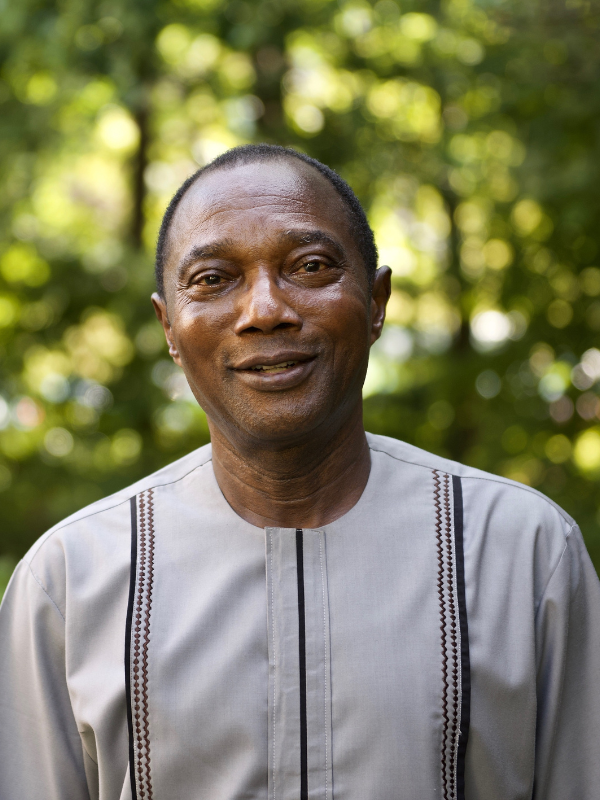
About Tanure Ojaide
A Fellow in Writing at the University of Iowa, Tanure Ojaide was educated at the University of Ibadan, where he received a bachelor’s degree in English, and at Syracuse University, where he received both an M.A. in Creative Writing and Ph.D. in English. Ojaide has published twenty-nine collections of poetry, as well as four novels, five short story collections, three memoirs, and fourteen self-authored and co-authored scholarly books. He has won the Association of Nigerian Authors’ Poetry Prize four times (1988, 1994, 2003, and 2011). His other awards include the Commonwealth Poetry Prize for the Africa Region (1988), the All-Africa Okigbo Prize for Poetry (1988), and the BBC Arts and Africa Poetry Award (1988). He was the Winner of the University of North Carolina at Charlotte’s prestigious First Citizens Bank Scholar Medal Award for 2005. In 2016, he won both the African Literature Association’s Folon-Nichols Award for Excellence in Writing and the Nigerian National Order of Merit Award for the Humanities. In 2018 he co-won the Soyinka Prize for Literature in Africa. He has won the National Endowment for the Humanities grant, twice the Fulbright Senior Scholar fellowship, and twice the Carnegie African Diaspora Program fellowship. A fellow of the Nigerian Academy of Letters and of the Association of Nigerian Authors, Ojaide is currently the Frank Porter Graham Distinguished Professor of Africana Studies at the University of North Carolina, Charlotte.